

By A Correspondent
New Delhi: India is working towards a complete ‘Make in India’ mobile phone, from the chip to the handset, and has now democratised the telecommunication technology, making it inclusive and empowering women, Prime Minister Narendra Modi said today.
Inaugurating the International Telecommunication Union (ITU) – World Telecommunication Standardization Assembly (WTSA) 2024 at Bharat Mandapam here, Modi said, “In India, we have made telecom not just a medium of connectivity, but also a medium of equity and opportunity.”
He also inaugurated the 8th edition of the India Mobile Congress and walked through the exhibition of telecommunication technology put up by companies at the venue.
India’s Cabinet Minister for Communication Jyotiraditya Scindia, Minister of State for Communication Chandrasekhar Pemmasani, and ITU Secretary-General Doreen Bogdan-Martin listened to the Prime Minister’s address at the event.
The participants included foreign dignitaries, industry leaders, telecom experts, and Startup representatives, besides ITU, WTSA, and India Mobile Congress (IMC) members.
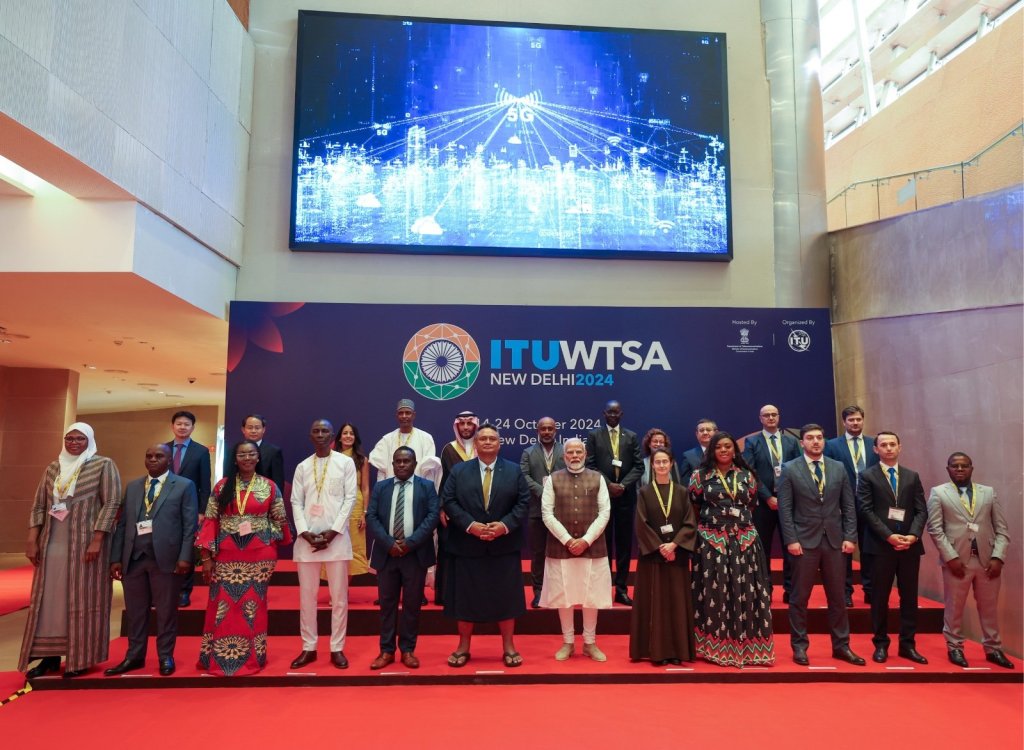
Modi thanked the ITU for choosing India as the destination for the first WTSA meeting. “India is one of the most happening countries for telecom and its related technologies,” Modi said. India had a mobile phone user base of 120 crores or 1200 million, 95 crore or 950 million internet users, and digital transactions of more than 40 percent of the world in real-time.
He said India had showcased how digital connectivity had become an effective tool for last-mile delivery. He congratulated everyone for choosing India to discuss the global telecommunication standard and the future of telecom as a global good.
The Prime Minister said WTSA’s objective is to work on global standards while the role of India Mobile Congress is associated with services. He said the event brings global standards and services on a single platform. Emphasizing India’s focus on quality service and standards, the Prime Minister said that WTSA’s experience would provide new energy to India.
The Prime Minister underlined that WTSA empowers the world via consensus while India Mobile Congress strengthens the world through connectivity. Therefore, Modi said, consensus and connectivity are conjoined in this event.
He stressed the need for the combination in today’s world marred by conflict and said India has been living through the immortal message of ‘Vasudhaiva Kutumbakam’ (The World is One Family). He mentioned the G20 Summit presidency of India in 2023 and spoke about relaying the message of ‘One Earth, One Family, One Future.’
The Prime Minister emphasized that India is bringing the world out of conflict and connecting it. “Be it the ancient silk route or today’s technology route, India’s only mission is to connect the world and open new doors of progress.” In such a situation, he said, the partnership of WTSA and IMC is a great message where local and global combine to benefit not just one country but the entire world.
“India’s mobile and telecom journey in the 21st century is a subject of study for the whole world,” Modi said, adding that while mobile and telecom were seen as a facility across the world, telecom was not just a medium of connectivity, but a medium of equity and opportunity in India.
The Prime Minister remarked that telecom as a medium was helping in bridging the gap between villages and cities, rich and poor today. Reminiscing his presentation, a decade ago, on the vision of Digital India, Modi said India had to move forward with a holistic approach as against a piecemeal approach.
Modi listed the four pillars of Digital India: Low-priced devices, extensive reach of digital connectivity to every nook and corner of the country, easily accessible data, and the goal of ‘Digital First.’ These pillars were identified and worked upon simultaneously, leading to good results.
The Prime Minister highlighted India’s transformative achievements in connectivity and telecom reforms and emphasized how the country has built a robust network of thousands of mobile towers across remote tribal, hilly, and border areas, ensuring connectivity for every household.
He said the government has created a strong network of mobile towers nationwide. The Prime Minister underscored the remarkable advancements in infrastructure, including the rapid installation of Wi-Fi facilities at public places like railway stations and the connection of islands like Andaman-Nicobar and Lakshadweep through undersea cables. “In just 10 years, India has laid optical fiber which is eight times the distance between Earth and the Moon,” he added.
Modi also pointed out India’s rapid adoption of 5G technology in the last two years. Today, nearly every district is connected, making India the world’s second-largest 5G market. He further mentioned that India is already progressing towards 6G technology, ensuring a future-ready infrastructure.
Discussing telecom sector reforms, the Prime Minister noted India’s efforts to reduce data costs. He said that the cost of internet data in India is now as low as 12 cents per GB compared to many countries globally where one GB of data is 10 to 20 times more expensive. “Today, every Indian consumes about 30 GB of data on an average every month,” he said.
Modi noted that all such efforts have been taken to a new scale by the fourth pillar, which is the spirit of Digital First. He underlined that India democratised digital technology and created digital platforms where innovations on these platforms created millions of new opportunities.
Modi highlighted the transformative power of the JAM Trinity — Jan Dhan, Aadhaar, and Mobile — saying it has laid the foundation for countless innovations. He mentioned Unified Payments Interface (UPI) which has provided new opportunities for many companies and spoke about ONDC which will revolutionise digital commerce.
The Prime Minister pointed out the role of digital platforms during the COVID-19 pandemic ensuring seamless processes such as financial transfers to those in need, real-time communication of guidelines, vaccination drive, and handing out digital vaccine certificates.
The Prime Minister expressed the nation’s willingness to share its digital public infrastructure experience globally. India’s digital bouquet can elevate welfare schemes worldwide. The PM highlighted India’s emphasis on Digital Public Infrastructure during the G20 Presidency. He noted that the nation is happy to share its DPI knowledge with all countries.
Emphasizing the importance of the Network of Women initiative during the WTSA, Modi said India was working very seriously on women-led development. He added that the commitment was taken forward during India’s presidency of G-20.
The Prime Minister underlined that India was working towards making the technology sector inclusive by empowering women through technology platforms. He highlighted the crucial role of women scientists in India’s Space missions and the rising number of women co-founders in India’s start-ups.
The Prime minister also noted that there was a 40 percent share of women students in India’s STEM education and India was creating umpteen opportunities for women in technology leadership. Modi said the ‘Namo Drone Didi’ government programme to promote the drone revolution in agriculture, was being led by women from villages in India.
He added that India also started the ‘Bank Sakhi’ programme to take digital banking and digital payments to every home, leading to digital awareness. Mentioning the critical role of ‘Asha’ and ‘Anganwadi’ workers in India’s primary healthcare, maternity, and child care, Modi remarked that today these workers tracked all the work through tabs and apps.
India also ran the ‘Mahila e-Haat’ programme, an online marketing platform for women entrepreneurs. He further said it was unimaginable that today Indian women in every village were working on such technology. Modi expressed hope that in the times to come, India will expand its scope further where every daughter of India would be a tech leader.
The Prime Minister reiterated the importance of establishing a global framework for digital technology. He emphasized that this topic was raised by India during its G-20 Presidency and urged global institutions to recognise its significance for global governance.
“The time has come for global institutions to accept the importance of global governance,” the PM stated. Stressing the need to create “Do’s and Don’ts” for technology globally, the Prime Minister highlighted the borderless nature of digital tools and applications and urged for international collaboration in combating cyber threats and collective action by global institutions.
He drew parallels with the aviation sector which already has well-established frameworks. Modi called upon the WTSA to take a proactive role in creating a secure digital ecosystem and safe channel for telecommunication. “In an interconnected world, security cannot be an afterthought. India’s Data Protection Act and National Cyber Security Strategy reflect our commitment to building a safe digital environment,” he noted.
The Prime Minister urged the assembled members to create inclusive and secure standards that respect nations’ diversity and are adaptable to future challenges, including ethical AI and data privacy.
He emphasised the need for a human-centric dimension to the emerging technological revolution, calling for responsible and sustainable innovation. He said today’s standards will determine the future direction, stressing that security, dignity, and equity should be the centre of discussions.
He said our goal should be that no country, region, or community is left behind in this digital transformation and underscored the need for innovation balanced with inclusion. He urged to ensure that the future is technically strong and ethically sound with innovation and inclusion.
Background
The WTSA is the governing conference for the standardization work of the International Telecommunication Union, the United Nations Agency for Digital Technologies, organised every four years. The ITU-WTSA is hosted in India for the first time, covering the Asia-Pacific. It is a pivotal global event that will bring together more than 3,000 industry leaders, policy-makers, and tech experts from over 190 countries, representing telecom, digital, and ICT sectors.
WTSA 2024 will provide a platform for countries to discuss and decide the future of standards of next-generation critical technologies like 6G, AI, IoT, Big Data, cybersecurity, etc. Hosting this event in India will provide the country an opportunity to play a key role in shaping the global telecom agenda and set the course for future technologies. Indian startups and research institutions are set to gain critical insights into developing Intellectual Property Rights and Standard Essential Patents.
India Mobile Congress will showcase India’s innovation ecosystem, where leading telecom companies and innovators will highlight advancements in Quantum technology and Circular Economy along with a spotlight on 6G, and 5G use-case showcases, cloud & edge computing, IoT, semiconductors, cybersecurity, green tech, satcom and electronics manufacturing.
India Mobile Congress, Asia’s largest digital technology forum, has become a well-known platform across the globe for showcasing innovative solutions, services, and state-of-the-art use cases for industry, government, academics, startups, and other key stakeholders in the technology and telecom ecosystem.
The India Mobile Congress will showcase over 400 exhibitors, about 900 startups, and participation from over 120 countries. The event also aims to showcase more than 900 technology use case scenarios and host more than 100 sessions and discussions with over 600 global and Indian speakers.
Categories: Economy, Industry, Infrastructure, Science and Technology


 Political.Capital